

Articles
Summary:
If you've tried the eye creams, cut back on salt, started sleeping earlier, and your eye bags are still there, the problem may not be your lifestyle at all. Persistent under-eye puffiness can come down to anatomy.
Fat that's shifted forward beneath the eye may not respond to skincare or sleep, but may respond to a surgical procedure, such as lower blepharoplasty (eyelid surgery). Knowing that early can save you a lot of time and money spent on treatments unlikely to deliver the result you're looking for.
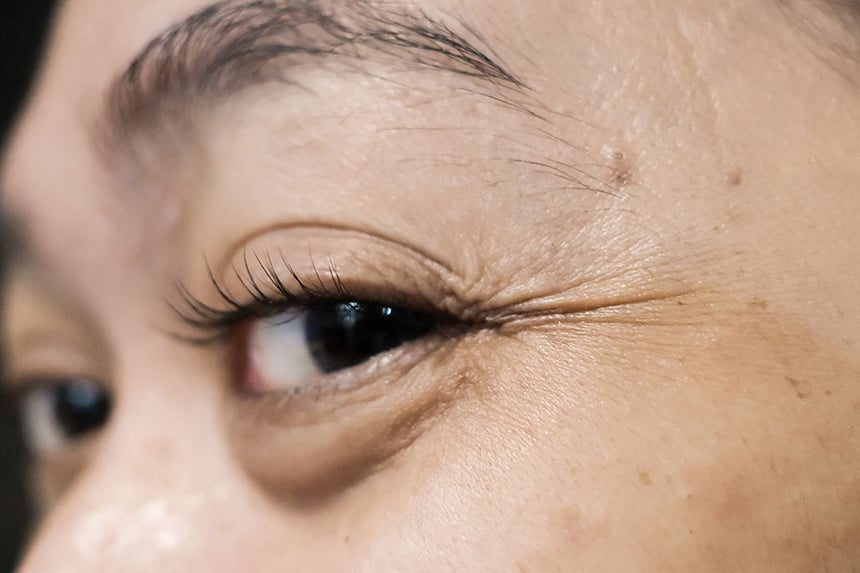
Eye bags are pockets of puffiness beneath the lower eyelid, caused by fat, fluid, or loose skin. Sometimes, it’s due to all three. Here's why eye bags form:
A fat herniation is the forward bulging of fat pads that normally sit behind the eye. The lower eyelid is supported by a thin membrane called the orbital septum, which tends to weaken with age. As it loses its ability to hold the fat in place, the fat may push forward and create a visible bulge beneath the eye.
In younger patients, hereditary factors are often a contributing cause of early lower eyelid puffiness. Skin laxity (the loss of firmness and elasticity in the skin) may also play a role. As collagen production slows with age, the skin beneath the eye tends to become thinner and potentially less able to conceal the underlying fat.
A few lifestyle factors may contribute to temporary under-eye puffiness, including:
These tend to be temporary. If structural fat herniation is also present, though, lifestyle changes alone aren't likely to resolve the issue.
If you're not ready for lower eyelid surgery in Singapore, or if your eye bags are mild, there are non-surgical options worth knowing about. They won't work for everyone, and it's important to understand what they can and can't do before spending money on them.
Dermal fillers injected into the tear trough (the groove between the lower eyelid and the cheek) may reduce the appearance of eye bags by adding volume to the surrounding area.
At Polaris, hyaluronic acid (HA) fillers are used for this purpose. HA is a substance found naturally in the body, which, in addition to adding volume, also attracts water to the surrounding area to enhance its effect. This can create a more subtle transition between the eyelid and cheek, making the bags appear less prominent.
A systematic review of 23 studies found that results for fillers typically lasted between eight and 12 months, with patient satisfaction generally high. Fillers may be more suited for those with mild to moderate eye bags.
Radiofrequency (RF) and laser treatments may help tighten the skin beneath the eye and stimulate collagen production. Polaris offers several options in this category, including:
These treatments may be useful for addressing skin laxity and superficial discolouration, and could provide modest improvement in the appearance of mild eye bags. Multiple sessions are usually required, and results tend to be more subtle compared to surgery.
Non-surgical treatments may improve the appearance of eye bags in mild cases, but they don't remove or reposition fat. If the underlying cause is fat herniation, non-surgical approaches are likely to offer only partial improvement. For many patients, these treatments delay rather than replace the need for lower eyelid surgery.
If you've already tried non-surgical treatments without the results you were hoping for, it may be worth finding out whether a structural cause is behind your eye bags. A consultation with a plastic surgeon can clarify this and outline what your options actually are. Speak to our doctors at Polaris Plastic & Reconstructive Surgery.
When non-surgical treatments aren't enough, surgery is often the most effective route. Lower blepharoplasty has been performed for decades and, depending on the technique, it can address the underlying fat herniation that other treatments simply can't reach.
Lower blepharoplasty is a surgical procedure that addresses the structural causes of eye bags. Depending on the technique used, the surgeon removes, repositions, or redistributes the herniated fat beneath the eye. In some cases, excess skin is also removed. The aim is a smoother, more rested appearance to the lower eyelid that's generally long-lasting.
Transconjunctival blepharoplasty is performed through a small incision made on the inside of the lower eyelid (through the conjunctiva, the mucosal layer lining the inner eyelid), leaving no visible scar on the skin surface.
The surgeon accesses and removes or repositions the fat pads through this internal approach, and, where relevant, releases the ligament that contributes to the prominence of the eye bags.
A 2025 study reported a patient satisfaction rate of 96.6% with this approach and a low rate of complications. It tends to suit patients who have good skin elasticity and don't require excess skin removal.
When there's significant skin laxity or excess skin in addition to fat herniation, an external incision approach may be more appropriate. At Polaris, this is offered as pinch lower blepharoplasty, in which a fine incision is made just below the lash line to allow the surgeon to address both fat and excess skin. When placed correctly, this incision is typically well-concealed and may fade to near-invisibility over several months.
Lower blepharoplasty can be performed alongside upper eyelid surgery or other facial rejuvenation procedures. For patients with contributing loss of cheek volume, periorbital fat grafting can be performed in the same sitting. A simultaneous midface lift is also possible where appropriate. Combining procedures may reduce overall recovery time compared to staging them separately.
Whether surgery is appropriate, and which type, depends largely on what's actually going on beneath your lower eyelid. The same procedure isn't right for everyone, and a surgeon will look at several factors before making a recommendation.
| Patient Profile | Recommended Approach |
| Good skin elasticity, fat herniation without excess skin | Scarless transconjunctival blepharoplasty |
| Skin laxity, fine lines, or excess skin alongside fat herniation | Pinch lower blepharoplasty |
| Volume loss in the cheek or tear trough area | Periorbital fat grafting, possibly combined with the above |
| Pre-existing dry eye syndrome, thyroid eye disease, or clotting conditions | Requires specialist assessment before surgery |
Before your consultation, consider noting:
Not sure where you land on that list? Our surgeons at Polaris Plastic & Reconstructive Surgery will assess your lower eyelid anatomy and walk you through the approach most likely to work for your situation. Book a consultation today.
Recovery from lower eyelid surgery is generally more manageable than people expect. Most of the visible bruising and swelling resolves within a couple of weeks, though full results take a little longer to settle.
Lower blepharoplasty (eyelid surgery) in Singapore is considered a long-lasting solution. Once fat's removed or repositioned, it doesn't typically return. However, the natural ageing process continues, and some patients may notice gradual changes to the surrounding skin and eyelid tissue over time.
The cost of lower eyelid surgery in Singapore varies depending on the technique used, the surgeon's experience, facility fees, and anaesthesia (the use of medication to prevent pain during surgery). A detailed cost breakdown should be provided during your consultation at Polaris Plastic & Reconstructive Surgery.
With the transconjunctival approach, there's no visible external scar. With the pinch lower blepharoplasty technique, the scar is placed very close to the lash line and, in many cases, becomes difficult to detect within several months as it fades. Scar outcome depends on individual healing, adherence to post-operative care, and sun protection.
Some patients may notice mild changes over many years as the ageing process continues, but the structural correction achieved through surgery tends to be long-lasting in most cases.
If you're considering eye bag removal and want advice tailored to your anatomy and goals, the team at Polaris Plastic & Reconstructive Surgery can help. We offer a full range of lower eyelid surgery options in Singapore, including scarless transconjunctival blepharoplasty, pinch lower blepharoplasty, and periorbital fat grafting, as well as non-surgical alternatives.
To arrange a consultation, contact Polaris Plastic & Reconstructive Surgery today.







Learn more about Dr Adrian Ooi, Dr Pek Chong Han, Dr Pek Wan Sze and the team