

Articles
Summary:
A mummy makeover in Singapore is a personalised combination of surgeries designed to address post-pregnancy changes that affect how you look and feel. It can be particularly helpful if you find that your body is not responding to diet and exercise.
Read on to know what kinds of procedures are typically done together and what the recovery process is like.
Here's what's actually happening to your body, and why a combination often makes more sense than treating each area on its own.
Pregnancy stretches the abdominal skin and muscles, and it changes breast volume and shape as your body prepares for and then recovers from breastfeeding.
For many women, the abdominal muscles separate along the midline, a condition called diastasis recti.
It can leave a visible bulge and a feeling of core weakness, even after your weight has returned to its previous level. Alongside this, breast tissue often loses volume and firmness, sometimes leaving the breasts sitting lower than before.
Exercise can rebuild strength in the muscles around a diastasis, and it can help you lose fat that built up during pregnancy. What it typically cannot do is close a wide muscle separation, tighten skin that has lost its elasticity, or restore breast volume that has genuinely been lost.
These are structural changes, not fitness ones, which is why some women reach a point where diet and training stop making a visible difference.
Combining procedures into a single operation means one recovery period, one round of time away from a young family, and one anaesthetic exposure instead of two or three separate ones.
For many mothers, this practical consideration matters as much as the surgical outcome itself.
This combination is often considered by women who have completed their families, maintained a stable weight, and are concerned about several post-pregnancy changes at the same time.
These may include loose abdominal skin or separated abdominal muscles, together with changes in breast shape, position, or volume.
A mummy makeover isn't one fixed package. It's built from a small set of procedures, chosen and combined based on what your body needs.
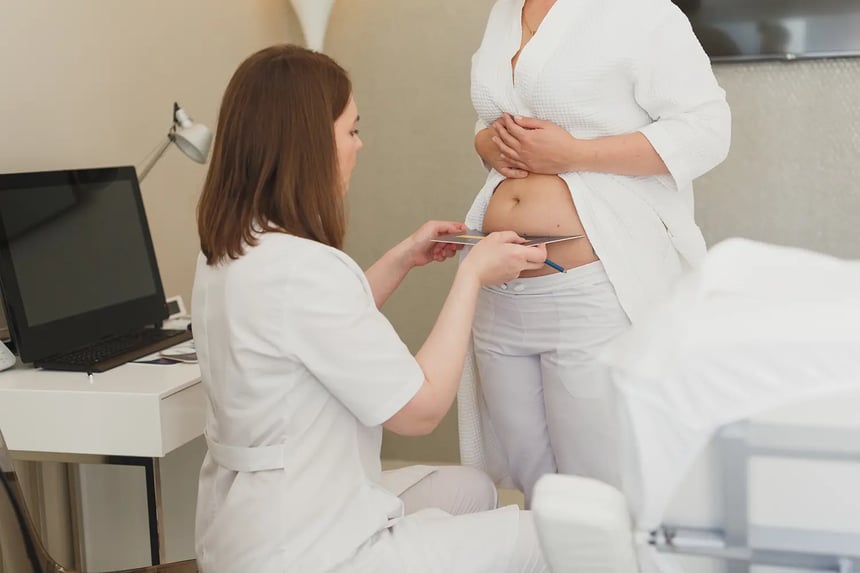
An abdominoplasty (tummy tuck) removes excess loose abdominal skin and repairs separated muscles so the abdominal wall sits flatter and firmer.
Depending on the extent of skin and muscle separation, a smaller version of this procedure, mini abdominoplasty, may be suitable instead of the full procedure.
Where breasts have lost position rather than volume, a breast lift (mastopexy) repositions the breast tissue and nipple higher on the chest wall.
Where volume loss is the main concern, breast augmentation with implants restores fullness. Some women need both together, since a change in position and a volume change often occur at the same time after pregnancy.
Liposuction is often added to refine the waistline and flanks, working alongside the abdominoplasty rather than replacing it.
It addresses fat deposits that diet and exercise haven't shifted, and it's usually planned alongside the abdominal work rather than as a separate operation.
Depending on individual goals, some patients also ask about facial fat grafting, minor hernia repair carried out at the same time as the abdominal work, or, less commonly, feminine rejuvenation procedures.
These are add-ons rather than standard components, and whether they make sense for you depends on your specific anatomy and priorities.
If you're trying to work out which of these apply to your situation, a consultation with the Polaris team can give you the answer you need. Contact us today.
Combining everything into one session isn't automatically the right call for every patient. Sometimes a staged approach might be better. Here's how the two approaches compare.
Performing the abdominal, breast, and liposuction components together in one operation means one recovery period and one period of time away from work and childcare. It's the option most mothers ask for first, largely for this practical reason.
In some cases, it may be safer to split the procedures across two or more operations spaced several months apart.
This may be recommended when a patient's overall health, the total expected operating time, or specific anatomical factors make one longer surgery less suitable.
Staging does not mean compromising on the outcome. It simply allows each procedure and recovery period to be managed separately when that is the safer approach.
Longer combined procedures can carry a different risk profile from a single procedure performed alone.
Research on combined plastic surgery procedures has found a higher overall complication rate compared with single procedures. However, combining abdominal and breast surgery specifically was not associated with higher short-term complication rates than undergoing either procedure separately.
Individual factors still matter. A higher body mass index, longer operating time and other health considerations can affect your risk. This is why your surgeon will assess whether combining procedures is appropriate for you, rather than treating a mummy makeover as a one-size-fits-all operation.
Recovery also needs to be considered alongside surgical risk. After a combined procedure, you can expect several weeks of restrictions on lifting and strenuous activity, which may include being unable to lift or carry your child, as well as the usual post-operative swelling and discomfort.
Staging the procedures separates these recovery periods and may be more practical for patients who do not have consistent help at home during the initial weeks after surgery.
Your surgeon will build your treatment plan around four key considerations.
Your surgeon will assess the extent of muscle separation, how much loose skin is present, and how much of the change is fat rather than skin or muscle. This determines whether a full abdominoplasty, a mini abdominoplasty, or liposuction alone is the better fit.
Your surgeon will look at where the nipple sits relative to the breast crease, how much volume has been lost, and how much skin laxity is present. This determines whether a lift, augmentation, or both are recommended.
If you're planning further pregnancies, your surgeon may recommend waiting, since a future pregnancy can affect both the abdominal muscle repair and any breast surgery results. This is usually discussed at your first consultation.
Most surgeons recommend waiting until breast changes and weight have stabilised for several months after childbirth, and until breastfeeding has fully stopped, before finalising a plan. This gives a clearer, more stable picture of what actually needs correcting, rather than operating on a body that's still changing.
If you're weighing up combined surgery against staged procedures for your situation, we can walk you through which approach fits your anatomy and recovery circumstances. Contact Polaris Plastic and Reconstructive Surgery today.
It is equally important to understand the limitations of the surgery and what to look out for during recovery.
A mummy makeover addresses skin, muscle and volume changes. It does not change your weight, and it isn't a substitute for reaching a stable weight beforehand. It also won't prevent the effects of a future pregnancy on the same tissues.
As with any surgery, risks include bleeding, infection, wound healing problems, and scarring.
These risks are generally higher the longer a combined procedure runs, which is part of why your surgeon will set a limit on how much can safely be combined in one session for you specifically.
Contact your surgical team promptly if you notice increasing pain rather than gradual improvement, fever, spreading redness, unusual drainage from a wound, or swelling in one leg that feels different from the other.
These aren't expected parts of a normal recovery and warrant a review rather than waiting it out.
It's a planned combination of body-contouring procedures, usually addressing the abdomen and breasts together, designed for women whose bodies have changed after pregnancy and childbirth in ways that exercise alone hasn't resolved.
Most combinations include abdominoplasty (or mini abdominoplasty), liposuction of the waist and flanks, and either a breast lift or breast augmentation. Additional procedures may be added depending on individual goals.
Most surgeons recommend waiting until your weight and breast changes have stabilised for several months, and until breastfeeding has stopped, so the plan reflects your settled post-pregnancy body rather than one still in transition.
Often, yes, and many patients prefer this for the single recovery period it involves. Whether it's appropriate for you depends on your individual health, the total planned operating time, and your specific anatomy, which is why this is assessed on a case-by-case basis rather than assumed.
Most patients need one to two weeks before returning to light daily activity, with heavier lifting and exercise typically restricted for four to six weeks. Recovery timelines vary by individual and by which procedures were combined.
If you have been considering surgery for changes to your abdomen and breasts after pregnancy, the next step is understanding which options are appropriate for your anatomy, goals, and recovery needs.
At Polaris Plastic & Reconstructive Surgery in Singapore, we can assess these factors with you and discuss whether a combined procedure or staged approach for a mummy makeover may be more suitable. A consultation allows you to understand your options before deciding whether surgery is right for you.







Learn more about Dr Adrian Ooi, Dr Pek Chong Han, Dr Pek Wan Sze and the team