

Articles
Summary:
Breast enhancement can refer to several different procedures, from surgical augmentation with implants to a breast lift that reshapes and repositions the existing tissue without adding volume.
When comparing options for breast enhancement in Singapore, it is important to establish what you want to change, as breast size, shape, and position each require a different approach.
Breast enhancement is a broad term, and not every procedure changes the breasts in the same way.
In everyday conversation, these words are often used interchangeably.
Clinically, breast enhancement is the broadest term, covering any procedure that changes how the breast looks.
Enlargement and augmentation both refer more specifically to adding volume, whether through an implant or your own fat.
Some patients want their breasts larger overall. Others want them to sit higher, look fuller in the upper pole, or simply look more even between the two sides.
Different concerns call for different treatment goals, and the procedure that works for one may not address another.
Your breasts can change in different ways, and each requires a different approach:
Some patients have just one of these concerns, while others have a combination. This is why breast enhancement is planned around what specifically needs to change rather than choosing a procedure based on its name alone.
The terms you use when researching breast enhancement can lead you towards very different procedures:
There is more to comparing breast enhancement procedures than simply asking which creates the biggest change. At Polaris Plastic & Reconstructive Surgery, we evaluate options for patients based on four practical factors:
How much the procedure changes the appearance of the breasts, whether through increased volume, improved shape, a higher breast position, or a combination of these.
Some procedures provide changes that can last for many years, while others may require maintenance or repeat treatment to preserve the effect.
Surgical procedures require a dedicated recovery period and temporary activity restrictions. Non-surgical options generally involve less downtime, but the degree of change is also typically more limited.
Some results can be adjusted or reversed relatively easily, while others require further surgery if you decide you want a different result later.
Though each procedure has different considerations, we understand that patients often want to know, on a basic level, the degree of visible change they can expect. Here’s what you need to know.
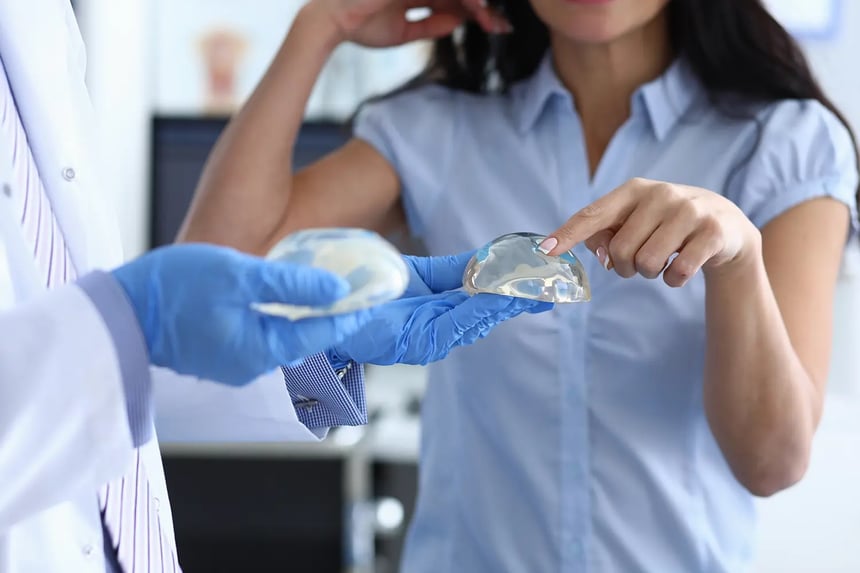
Breast augmentation with implants generally provides the largest and most predictable increase in breast volume.
Results are long-lasting, but implants are not necessarily lifetime devices, and some patients will require removal or revision in the future for reasons such as capsular contracture, implant-related complications or personal preference.
Fat transfer uses fat removed from another area of your body through liposuction to add volume to the breasts. The increase is typically more modest than with implants, and not all transferred fat survives.
Studies report long-term fat retention of around 50% to 70%, meaning the final result may be less predictable than the volume seen immediately after treatment.
A breast lift addresses a different goal altogether. It raises and reshapes existing breast tissue and repositions the nipple, making it most relevant when sagging is the main concern.
A lift alone does not significantly increase breast volume. If both sagging and lost fullness need to be addressed, it may be combined with an implant or fat transfer to change both position and volume.
Topical creams, massage devices, and supplements marketed for breast enhancement deliver the least change of any option, and we're not aware of robust clinical evidence supporting a meaningful, lasting increase in breast size or firmness from any of these. They involve no downtime, but that comes with a correspondingly limited effect.
The right choice depends on your own anatomy rather than the ranking alone. Speak to Polaris Plastic & Reconstructive Surgery about which of these options applies to you.
The ranking above is a general guide. Which option suits you depends on what's causing the change you want to address.
If your breasts have always been smaller and skin quality is good, with the nipple sitting at or above the breast fold, an implant or fat transfer alone is often sufficient, without needing a lift.
Volume loss after pregnancy and breastfeeding is commonly assessed alongside abdominal changes, sometimes as part of a mummy makeover, since both areas are often affected by the same underlying changes.
If you have enough natural breast tissue but it's sitting lower than you'd like, a lift alone, without added volume, is often the more appropriate option.
Asymmetry is common and can involve a difference in size, shape, or position between breasts. Correcting it sometimes means treating each side differently, such as an implant on one side and a lift on the other, rather than applying the same procedure to both.
Before deciding on a procedure, it helps to understand not only what each option can achieve, but also its limitations and what recovery may involve.
No breast enhancement procedure can guarantee an exact cup size, as the final result depends on your starting anatomy, skin quality, and individual response to surgery.
A stable weight beforehand is also important, as significant weight changes afterwards can alter the shape and appearance of the breasts.
As with any breast procedure, risks include bleeding, infection, changes to nipple sensation, and, less commonly, nerve injury, since the nerves supplying the nipple run through the tissue involved in most of these procedures.
Implant-specific risks also include capsular contracture and, rarely, implant rupture.
Contact your surgical team promptly if you notice increasing pain rather than gradual improvement, fever, spreading redness, or unusual drainage from a wound. These aren't expected parts of normal recovery.
Breast enhancement is a broad term covering any procedure that changes how the breast looks, including implants, fat transfer, a lift, or a combination. The right option depends on whether your main concern is size, shape, or position.
Largely, yes. Both terms generally refer to increasing breast volume, whether through implants or fat transfer, as distinct from a lift, which changes position rather than size.
Yes. Fat transfer and a breast lift are both implant-free options, though each addresses a different concern: fat transfer adds modest volume, while a lift changes shape and position.
This varies by procedure. Implants generally hold their result for many years, though revision surgery is sometimes needed. Fat transfer results are typically permanent once the transferred fat has settled, but the retained volume is smaller. Lift results can be affected by future pregnancy, weight change, and normal ageing.
This depends on what "natural" means to you, whether that's a natural feel, a natural size relative to your frame, or a natural, non-operated appearance. Fat transfer tends to feel most like natural tissue since it is natural tissue, while implants offer more predictable volume. This is worth discussing directly with your surgeon.
Whether your priority is size, shape, or position, the right breast enhancement option depends on your starting anatomy and aesthetic goals
At Polaris Plastic & Reconstructive Surgery, our plastic surgeons assess implants, fat transfer, and lift procedures, alone or in combination, on a case-by-case basis. We understand everyone’s body is different and we want you to feel good on your terms.







Learn more about Dr Adrian Ooi, Dr Pek Chong Han, Dr Pek Wan Sze and the team